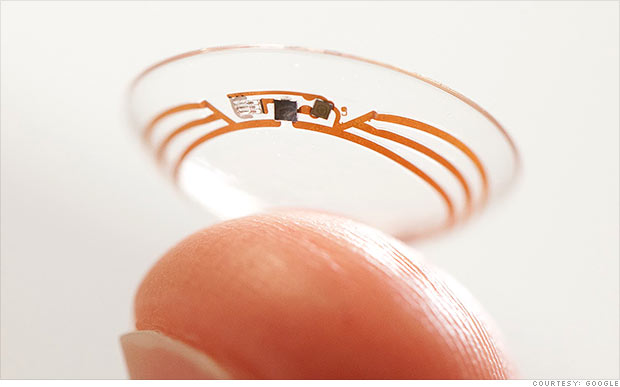
Google Smart Contacts May Help Monitor Blood Sugar in the Future


Google is rapidly developing new wearable technologies. Google's first attempt at wearable technology, Google Glass, has attracted a lot of press attention, but is still not available on the mass market. They also cost $1,500. Google's next foray into wearable technology maybe less flashy and less expensive, but may have a greater assistive technology impact.

Google's smart contact will sit on the eye like conventional contacts, but do much more. Google's initial idea is to measure blood sugar in tears for diabetics with electronics integrated into the contact. Instead of drawing blood to monitor blood sugar Google's smart contact would analyze blood sugar within tears. This system would eliminate or reduce painful finger pricks and also allow for more frequent testing. A small LED light inside the contact would then illuminate different colors depending on the blood sugar reading.

While this technology is still in development the idea is very exciting. If smart contacts could benefit diabetics maybe Google can adapt them to benefit people with other disabilities or conditions. Could a contact detect sound and give a visual notification to a deaf user? Imagine this, a smart contact for the deaf senses volume of sound and direction and notifies the user. A loud sound off towards a user's right side would illuminate the right LED very brightly while a soft sound off towards a user's left would dimly illuminate the left LED. While Google has only confirmed smart contacts are in testing for blood sugar testing it is exciting to think about the possibilities five or ten years down the line. Hopefully smart contacts for blood sugar monitoring will reach the market sooner than later and will assist people with diabetes.

Click read more to view a short video about Google smart contacts.


Comments

Popular posts from this blog

Emergent Cloud Computing Business Models

The last year I wrote quite a few posts on the business models around SaaS and cloud computing including SaaS 2.0 , disruptive early stage cloud computing start-ups , and branding on the cloud . This year people have started asking me – well, we have seen PaaS, IaaS, and SaaS but what do you think are some of the emergent cloud computing business models that are likely to go mainstream in coming years. I spent some time thinking about it and here they are: Computing arbitrage: I have seen quite a few impressive business models around broadband bandwidth arbitrage where companies such as broadband.com buys bandwidth at Costco-style wholesale rate and resells it to the companies to meet their specific needs. PeekFon solved the problem of expensive roaming for the consumers in Eurpoe by buying data bandwidth in bulk and slice-it-and-dice-it to sell it to the customers. They could negotiate with the operators to buy data bandwidth in bulk because they made a conscious decision not to st...

Reveiw: Celluon Epic Laser Keyboard

The Celluon Epic is a Bluetooth laser keyboard. The compact device projects a QWERTY keyboard onto most flat surfaces. (Glass tabletops being the exception) You can connect the Epic to vertically any device that supports Bluetooth keyboards including devices running iOS , Android , Windows Phone, and Blackberry 10. On the back of the device there is a charging port and pairing button. Once you have the Epic paired with your device it acts the same as any other keyboard. For any keyboard the most important consideration is the typing experience that it provides. The virtual keyboard brightness is adjustable and is easy to see in most lighting conditions. Unfortunately the brightness does not automatically adjust based on ambient light. With each keystroke a beeping sound is played which can be turned down. The typing experience on the Epic is mediocre at best. Inadvertently activating the wrong key can make typing frustrating and tiring. Even if you are a touch typist you'll still ...

Rise Of Big Data On Cloud

Growing up as an engineer and as a programmer I was reminded every step along the way that resources—computing as well as memory—are scarce. The programs were designed on these constraints. Then the cloud revolution happened and we told people not to worry about scarce computing. We saw rise of MapReduce, Hadoop, and countless other NoSQL technology. Software was the new hardware. We owe it to all the software development, especially computing frameworks, that allowed developers to leverage the cloud—computational elasticity—without having to understand the complexity underneath it. What has changed in the last two to three years is a) the underlying file systems and computational frameworks have matured b) adoption of Big Data is driving the demand for scale out and responsive I/Os in the cloud. Three years back, I wrote a post, The Future Of The BI In Cloud  where I had highlighted two challenges of using cloud as a natural platform for Big Data. The first one was to create a lar...