Inspiration Maps Updated with iPhone Support and More

Inspiration Maps displayed on iPhone 6

Inspiration Maps iconThe mind mapping and outlining app Inspiration Maps, which was previously only available on the iPad, is now available on the iPhone as well. The app is a valuable tool to help students organize their ideas and start the writing process. Users can drag text boxes around the screen to easily produce webs of ideas. Inspiration Maps is particularly helpful when writing about complex topics that require a well planned and organized essay. Inspiration Maps can be also be helpful when beginning an essay to visualize the structure that the written piece will take.

With the larger screen iPhone 6 and iPhone 6 plus in makes sense to bring the app to the iPhone. If you are concerned about not having enough room to effectively use the app on your iPhone, a free version is available here.

The update also makes in easier to select multiple text boxes or images at the same time. Now users can press and hold on the screen in order to lasso a group of images.

The updated app is available for $10 is the App Store. Click here to download the app. Click read more below to view more screenshots of Inspiration Maps for iPhone.


graphic highlighting brainstorming

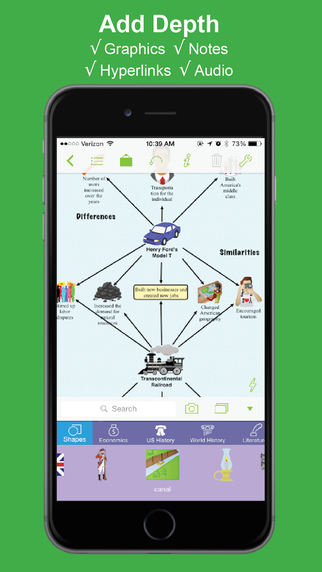
screenshot showing ability to add graphics, notes, hyperlinks, and audio

screenshot showing the ability to flip between web and outline view

Comments

Popular posts from this blog

Emergent Cloud Computing Business Models

The last year I wrote quite a few posts on the business models around SaaS and cloud computing including SaaS 2.0 , disruptive early stage cloud computing start-ups , and branding on the cloud . This year people have started asking me – well, we have seen PaaS, IaaS, and SaaS but what do you think are some of the emergent cloud computing business models that are likely to go mainstream in coming years. I spent some time thinking about it and here they are: Computing arbitrage: I have seen quite a few impressive business models around broadband bandwidth arbitrage where companies such as broadband.com buys bandwidth at Costco-style wholesale rate and resells it to the companies to meet their specific needs. PeekFon solved the problem of expensive roaming for the consumers in Eurpoe by buying data bandwidth in bulk and slice-it-and-dice-it to sell it to the customers. They could negotiate with the operators to buy data bandwidth in bulk because they made a conscious decision not to st...

Reveiw: Celluon Epic Laser Keyboard

The Celluon Epic is a Bluetooth laser keyboard. The compact device projects a QWERTY keyboard onto most flat surfaces. (Glass tabletops being the exception) You can connect the Epic to vertically any device that supports Bluetooth keyboards including devices running iOS , Android , Windows Phone, and Blackberry 10. On the back of the device there is a charging port and pairing button. Once you have the Epic paired with your device it acts the same as any other keyboard. For any keyboard the most important consideration is the typing experience that it provides. The virtual keyboard brightness is adjustable and is easy to see in most lighting conditions. Unfortunately the brightness does not automatically adjust based on ambient light. With each keystroke a beeping sound is played which can be turned down. The typing experience on the Epic is mediocre at best. Inadvertently activating the wrong key can make typing frustrating and tiring. Even if you are a touch typist you'll still ...

Rise Of Big Data On Cloud

Growing up as an engineer and as a programmer I was reminded every step along the way that resources—computing as well as memory—are scarce. The programs were designed on these constraints. Then the cloud revolution happened and we told people not to worry about scarce computing. We saw rise of MapReduce, Hadoop, and countless other NoSQL technology. Software was the new hardware. We owe it to all the software development, especially computing frameworks, that allowed developers to leverage the cloud—computational elasticity—without having to understand the complexity underneath it. What has changed in the last two to three years is a) the underlying file systems and computational frameworks have matured b) adoption of Big Data is driving the demand for scale out and responsive I/Os in the cloud. Three years back, I wrote a post, The Future Of The BI In Cloud  where I had highlighted two challenges of using cloud as a natural platform for Big Data. The first one was to create a lar...